vTune architecture
Early design sketch
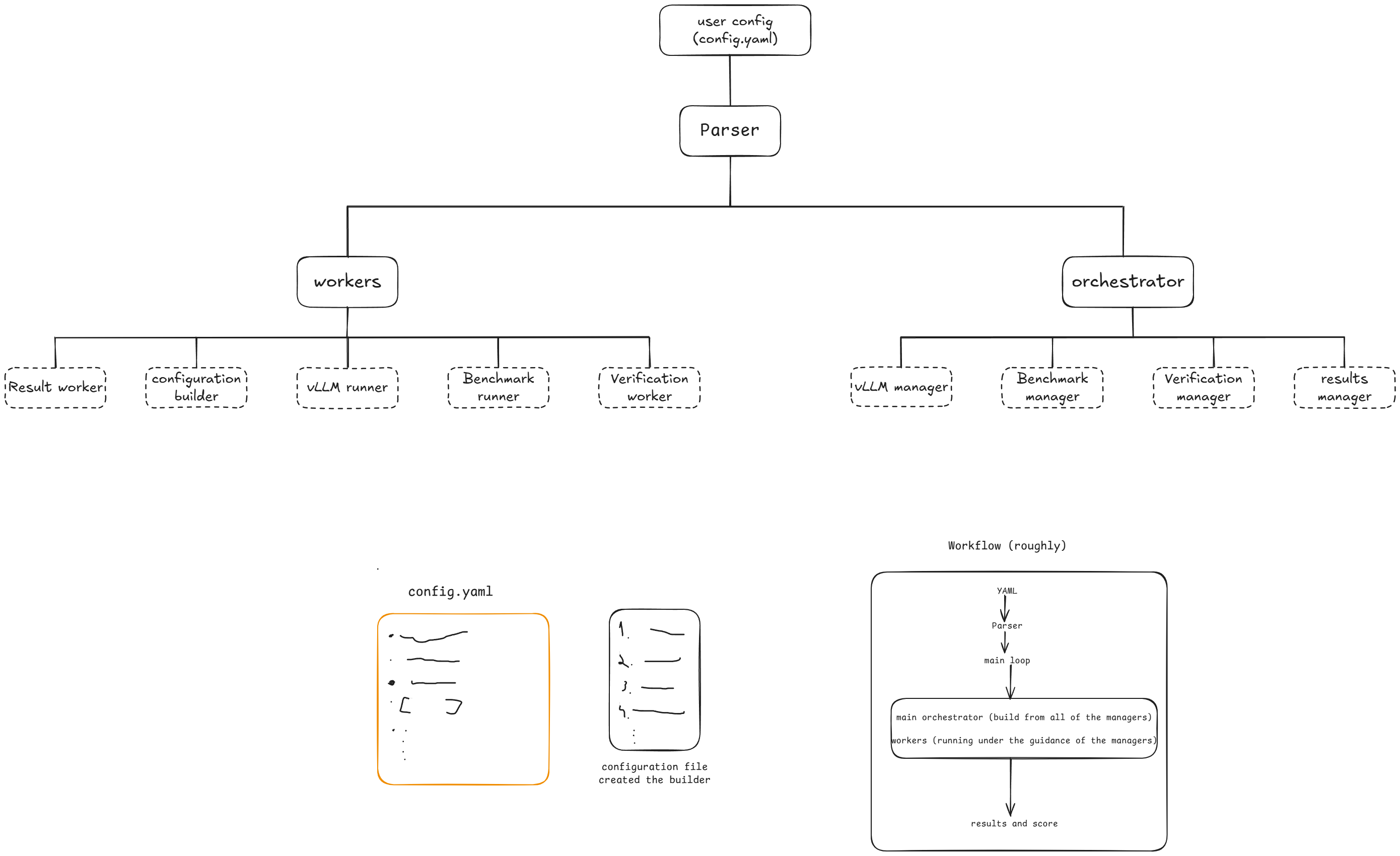
The sketch is preserved as the project's original manager-and-worker concept. The editable early diagram is vtune-architecture.drawio. Some boxes are aspirations rather than current classes.
Implemented flow
CLI → YAML loader → Orchestrator → SearchSession
                         │
                         └→ TrialManager
                              ├→ ConfigurationBuilderWorker
                              ├→ VLLMRunnerWorker
                              ├→ ReadinessWorker
                              └→ BenchmarkWorker(s)
                                      │
                                      └→ GuideLLM or vLLM Bench JSON

Trial results → RunAccumulator → result.json / CSV / HTML / Optuna SQLite
Ownership
cli.pyselects one user workflow and converts failures to exit codes.config/loads typed configuration and validates runtime policy.search/owns Grid, Random, and TPE suggestions. The orchestrator sees only theSearchSessionprotocol.Orchestratorowns the sequential run loop, immutable run directory, and incremental run persistence.TrialManagerowns worker ordering, attempts, reverse cleanup, and transient retry decisions for one trial.- Workers own one external action. They communicate through
TrialContextand return structured statuses instead of controlling the run. ProcessRunnerlaunches argument arrays without a shell, creates an owned process group, captures logs, and optionally mirrors DEBUG output.managers/scores and persists domain results.reporting/converts completed run data into CSV and static HTML.reproduction/records, validates, redacts, displays, and exports manifests.lifecycle/validates immutable source artifacts and builds manual retries.
Dependency direction
Domain records do not depend on vLLM, GuideLLM, Optuna, the CLI, or HTML. Workers depend on domain boundaries; managers coordinate domain records; the orchestrator composes them. External formats are normalized at the edge.
Extension points
- Add a worker by implementing the small
Workerprotocol inworkers/base.py. - Add a search strategy by implementing
SearchSessionand selecting it insearch/factory.py. - Benchmark engines keep command builders and parsers in
benchmarks/, with lifecycle workers selected inworkers/factory.py. - Add report sections in
reporting/without changing execution workers. - Add orchestration managers only when they own policy shared by multiple workers; do not rename a composed trial worker to a manager solely because it calls other code.
Current boundary
Sequential execution is the default. Local parallel execution requires explicit non-overlapping GPU workers and deterministic ports. Automatic GPU allocation, shared GPUs, and distributed workers remain roadmap work.