vLLM Optimizer architecture
Early design sketch
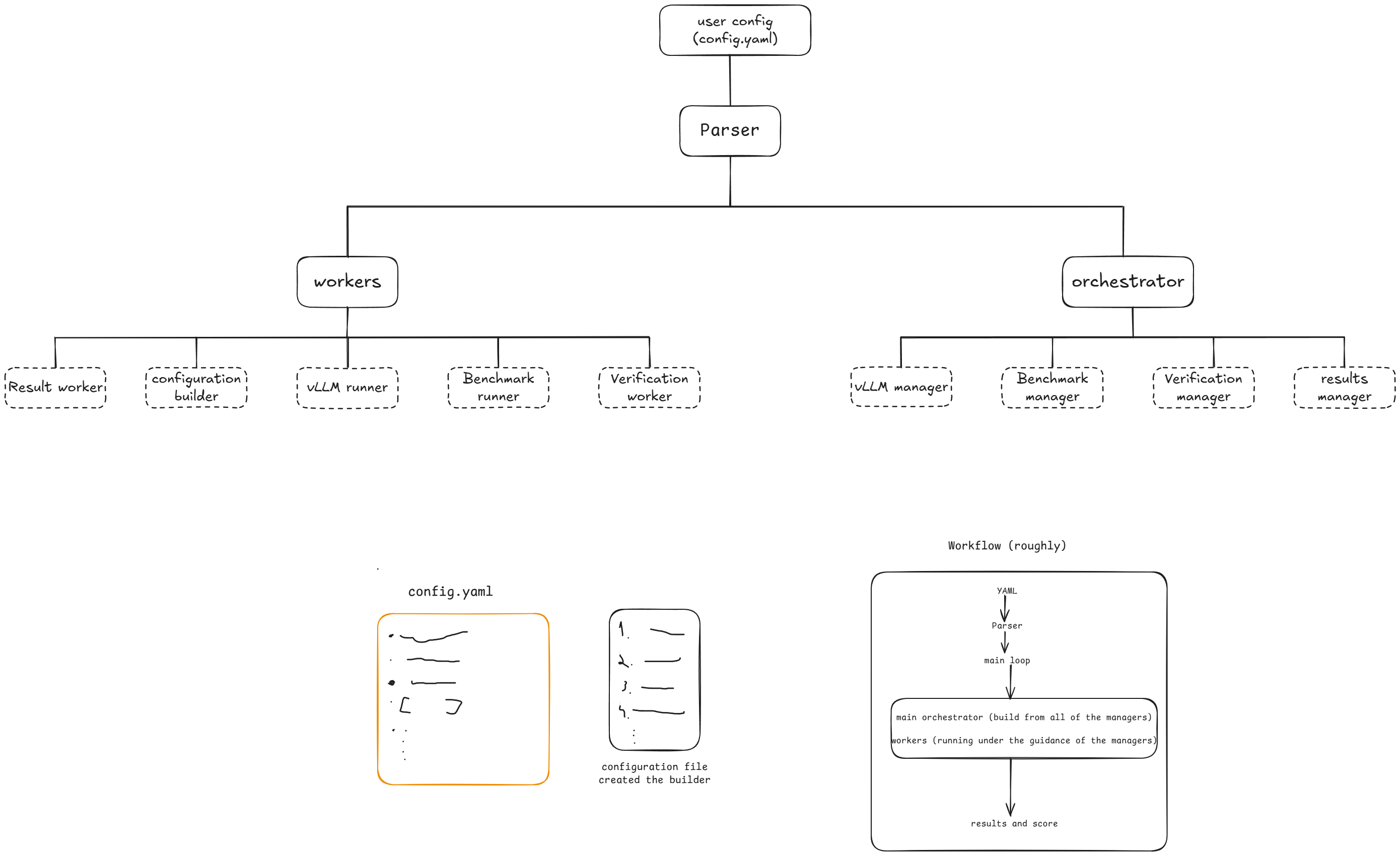
The sketch is preserved as the project's original manager-and-worker concept. The editable early diagram is vllm-optimizer-architecture.drawio. Some boxes are aspirations rather than current classes.
Implemented flow
CLI → YAML loader → Orchestrator → SearchSession
                         │
                         └→ TrialManager
                              ├→ ConfigurationBuilderWorker
                              ├→ VLLMRunnerWorker
                              ├→ ReadinessWorker
                              └→ BenchmarkWorker(s)
                                      │
                                      └→ GuideLLM or vLLM Bench JSON

Trial results → RunAccumulator → result.json / CSV / HTML / Optuna SQLite

The run-level `result.json` stores the effective repeat, warmup, drift, and
request-failure policy. Offline regeneration and reclassification reuse that
policy; legacy results derive compatible defaults from the trial manifest.
Ownership
cli.pyselects one user workflow and converts failures to exit codes.config/loads typed configuration and validates runtime policy.search/owns Grid, Random, and TPE suggestions. The orchestrator sees only theSearchSessionprotocol.Orchestratorcomposes a run.orchestrator_search.pyowns trial scheduling, whileRunFinalizerowns terminal cleanup and atomic terminal run states.TrialManagerowns worker ordering, attempts, reverse cleanup, and transient retry decisions for one trial.- Workers own one external action. They communicate through
TrialContextand return structured statuses instead of controlling the run. ProcessRunnerlaunches argument arrays without a shell, creates an owned process group, captures logs, and optionally mirrors DEBUG output.managers/scores and persists domain results; run-document serialization is separate from run finalization.reporting/converts completed run data into CSV and static HTML. Offline loading and reclassification scoring are isolated from report rendering.reproduction/records, validates, redacts, displays, and exports manifests.lifecycle/validates immutable source artifacts and builds manual retries.
Dependency direction
Domain records do not depend on vLLM, GuideLLM, Optuna, the CLI, or HTML. Workers depend on domain boundaries; managers coordinate domain records; the orchestrator composes them. External formats are normalized at the edge.
Extension points
- Add a worker by implementing the small
Workerprotocol inworkers/base.py. - Add a search strategy by implementing
SearchSessionand selecting it insearch/factory.py. - Benchmark engines keep command builders and parsers in
benchmarks/, with lifecycle workers selected inworkers/factory.py. - Add report sections in
reporting/without changing execution workers. - Add orchestration managers only when they own policy shared by multiple workers; do not rename a composed trial worker to a manager solely because it calls other code.
Current boundary
Sequential execution is the default. Local parallel execution requires explicit non-overlapping GPU workers and deterministic ports. Automatic GPU allocation, shared GPUs, and distributed workers remain roadmap work.