RTX 3080 local results
These are real inference measurements from one RTX 3080, 10 GiB, running Ubuntu under WSL2. The runs started on 13 September 2026 UTC. The historical reproduction files retain the exact YAML and its SHA-256. New H100 scenarios use your chosen models and GPU allocations.
Report showcase
Open the full interactive report.
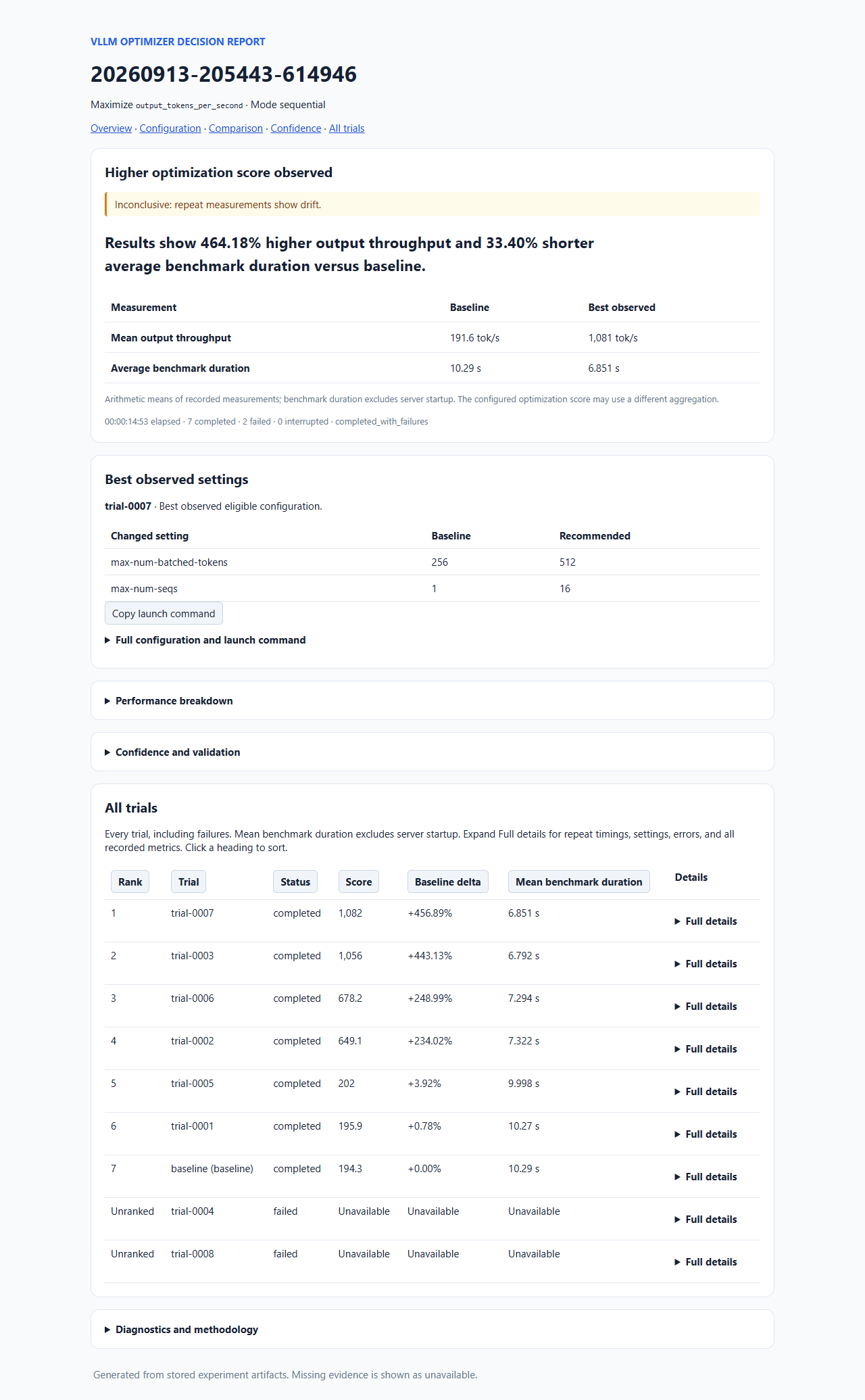
The accepted configuration changes max-num-seqs from 1 to 16 and
max-num-batched-tokens from 256 to 512. The configured score increased
from 194.34 to 1,082.27 output tokens/s (+456.89%). This score is the mean
of the two named workloads' repeat medians; their individual measurements and
latency percentiles remain separate in the report.
The experiment took 00:00:14:53: seven trials completed, including the baseline, and two deliberately invalid configurations failed. Both finalists were validated again, and the accepted ranking uses those validation results. The intentionally zero drift threshold makes the confidence verdict inconclusive due to drift, despite the large observed improvement. The concise summary compares arithmetic means: 464.18% higher output throughput and 33.40% shorter average benchmark duration versus baseline. This differs from the historical median-based score above. Every trial's average benchmark duration remains visible. Expand Full details for repeat timings, settings, errors, and all recorded trial data; performance breakdown, confidence evidence, and diagnostics start collapsed.
Baseline control
Open the baseline-control report.
This experiment starts with max-num-seqs: 16 and tests a restricted candidate
with max-num-seqs: 1; both retain max-num-batched-tokens: 512.
The baseline wins at 925.54 output tokens/s, versus 205.87 for
the candidate (-77.76%). The report recommends keeping the baseline with
no changed settings. Both trials completed without request failures in
00:00:01:32. With three repeats, drift assessment is unavailable.
The structured result's best field identifies the best search candidate;
the HTML compares that candidate with the separately stored baseline.
Workloads and interpretation
| Workload | Dataset | Input / output tokens | Requests per repeat | Concurrency | Request rate |
|---|---|---|---|---|---|
| short-chat | Seeded random | 64 / 32 | 16 | 8 | Unlimited |
| longer-prompt | Seeded random | 256 / 64 | 16 | 8 | Unlimited |
The showcase measures both workloads with four repeats each; the control uses
short-chat with three repeats. Every named workload has one excluded warmup.
The model is the pinned facebook/opt-125m revision recorded in the shared
recipes. The runtime is Python 3.12.3, vLLM 0.28.0, PyTorch 2.13.0/CUDA 13.0,
and driver 616.64. Complete package pins and model checksums are provided.
These deliberately small experiments exercise the decision report, supplied P50/P95/P99 metrics, benchmark execution durations, baseline retention, validation history, and failure diagnostics. They do not establish production performance or H100 speedups. The restricted showcase baseline is a demonstration choice.
Inspect or regenerate
The HTML is self-contained and opens directly after downloading. The compact normalized JSON retains per-request input/output lengths and sparse errors while omitting generated text and bulky timing traces. The ZIP contains the run directory, compact accepted and initial trial results, manifests, unchanged raw benchmark output, and diagnostic logs. It contains no model weights.
Personal paths and GPU UUIDs were redacted in the public copy. Artifact paths
and checksums were updated accordingly; scores, request counts, measurements,
and statuses were not changed. Untouched source artifacts were retained
privately, and their hashes are recorded in provenance.json.
For offline integrity checks, extract each archive into the
restoration_directory recorded in its provenance, preserving the timestamped
run directory, then run:
Opening the HTML alone does not require restoring paths or installing vLLM. No results in this folder have been measured on H100; that archive remains explicitly pending.